


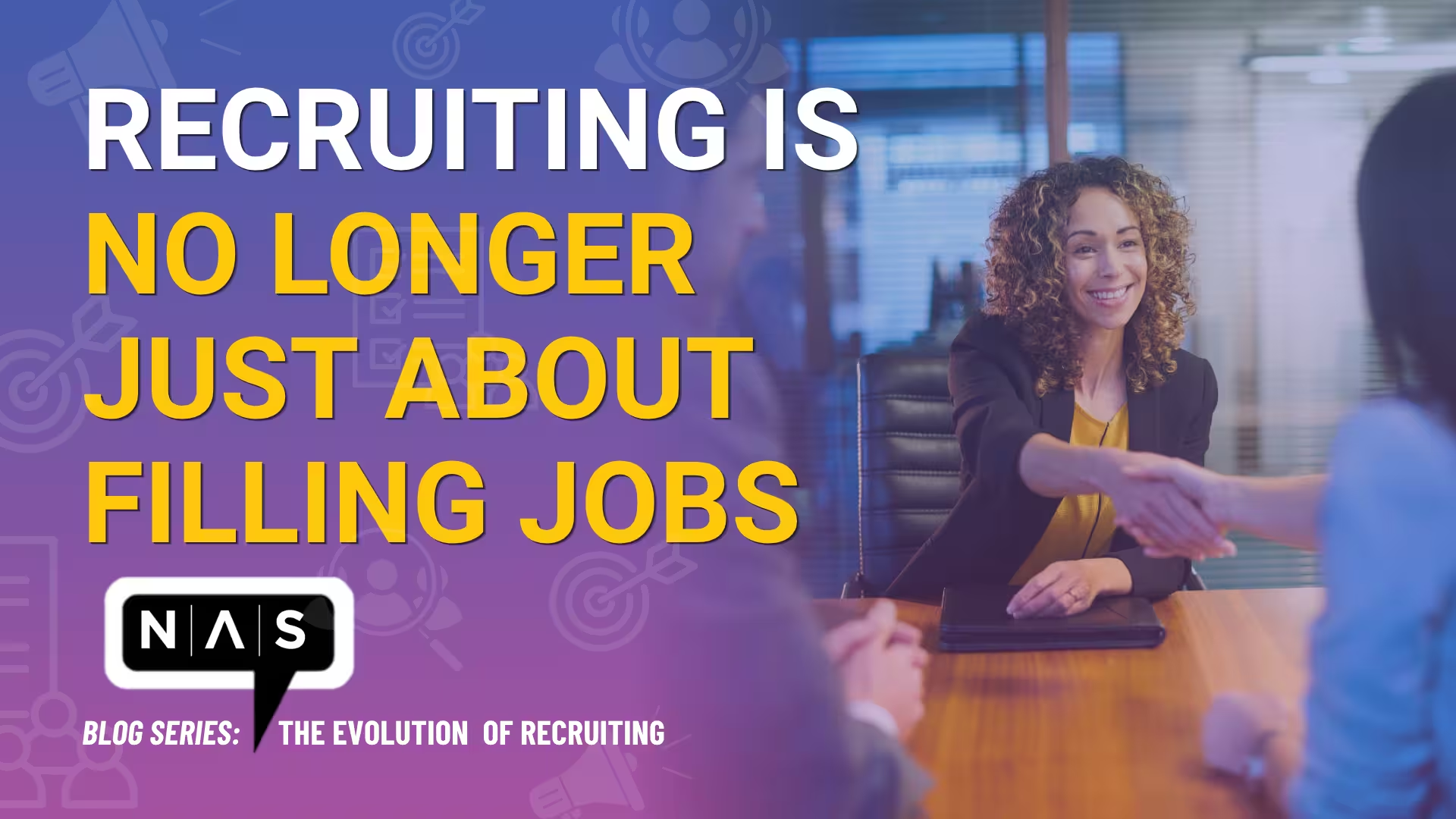
Recruiting Is No Longer Just About Filling Jobs
Posted by Matt Adam | Executive Vice President & Chief Talent StrategistSeptember 24, 2026

Matt Adam is Chief Talent Strategist at NAS Recruitment Innovation, where he helps organizations transform their talent acquisition strategies through employer branding, recruitment marketing, and modern career site experiences.
For decades, recruiting success was largely measured by a straightforward question: did we fill the open position?
That question still matters. But in my experience working alongside talent acquisition leaders across industries and markets, the organizations that are winning the talent competition right now aren't the ones moving fastest on open requisitions. They're the ones where TA has earned a seat at a different table entirely.
The workforce has changed. Candidate expectations have changed. The skills organizations need are shifting faster than most hiring structures were built to handle. And business leaders are under increasing pressure to make smarter decisions about where they invest, how they structure their workforce, and what talent they'll need not just today but a year from now.
Talent acquisition sits at the center of those conversations. The question is whether recruiting leaders are positioned to contribute to them.
From Reactive Recruiting To Workforce Strategy
Traditional recruiting begins with an open position. A hiring manager identifies a need, a job is posted, and the process starts.
Strategic talent acquisition starts earlier.
The TA leaders I see making the biggest organizational impact are the ones asking different questions before the requisition opens:
- What roles will this organization need six months from now?
- Which skills are becoming harder to find and what does that mean for how we hire today?
- Where is talent actually available, and does our strategy reflect that reality
- Are our job requirements aligned with the talent pool that exists, or are we building pipelines that will disappoint us?
These are workforce questions, not simply recruiting questions.
And leadership is paying attention. SHRM research shows that 40% of CHROs identify workforce planning as a top talent management priority, with a direct emphasis on aligning workforce needs with broader business objectives. That is an opening for talent acquisition. Not a given, but an opening.
Recruiting leaders have a perspective that few other functions possess: a real-time, unfiltered view of what's happening in the external market. They know where candidates are responding and where they're not. They see competitive pressure forming before it shows up in turnover reports. They know when a job requirement is unrealistic before a hiring manager does.
The earlier that intelligence enters strategic conversations, the better the decisions that follow.
Market Intelligence Should Drive Business Decisions
The labor market doesn't behave the same way across every role, geography, or skill set. A sourcing strategy that works for one job family falls flat for another. Compensation that's competitive in one market won't attract anyone in the next.
This is not new information. What's new is the expectation that TA will do something with it.
Gartner found that only 31% of recruiting functions use labor market data to shape business and talent strategies. That number is striking, not because it's a failure, but because of what it represents as an opportunity.
Recruiting teams already encounter and generate valuable intelligence every single day: talent availability, candidate behavior, compensation benchmarks, skills signals, competitive dynamics. Most of it never makes it into a strategic conversation. It stays in a report, on a dashboard, or in a recruiter's head.
The shift I'm encouraging TA leaders to make is this: stop reporting activity and start translating it.
Instead of reporting that a position has been open for 60 days, help leadership understand why. Is the talent pool smaller than anticipated? Are competitors offering something candidates value more? Are the role requirements creating unnecessary friction? Is the organization investing in the wrong channels?
Those are different conversations. And they lead to different decisions.
A More Competitive Market, Not An Easier One
There's a temptation to assume that a cooler labor market means recruiting is easier. It doesn't.
SHRM's 2026 Talent Trends Report found that 68% of U.S. organizations still report difficulty recruiting for full-time positions, and more than half of those say it's gotten harder compared to the year before. At the same time, Gartner found that 48% of HR leaders say the demand for new skills is evolving faster than their existing talent structures and processes can keep up with.
What we're dealing with is not a volume problem. It's a precision problem.
In this environment, TA leaders have to look beyond applicant counts. Sometimes the answer is a different sourcing strategy. Sometimes it's rethinking compensation or reconsidering a job requirement that's filtering out the right candidates. Sometimes it means helping the business understand that the role they've designed doesn't match the talent that exists.
Having those conversations requires credibility. And credibility comes from arriving at the table with data and perspective, not just a status update on open reqs.
Metrics Need To Mean Something
Time-to-fill, cost-per-hire, application volume: these will always be useful measures. But no single metric tells a complete story, and leading with activity metrics is one of the fastest ways to keep TA out of strategic conversations.
A low cost-per-application doesn't mean much if those applicants aren't qualified. A longer time-to-fill may look like a performance problem until labor market data shows the organization is competing for an exceptionally limited skill set. A large applicant pool can mask a candidate experience that's driving away the people most worth hiring.
The evolution I'm talking about isn't just philosophical. It shows up in how TA presents its work.
Moving beyond activity reporting means providing context alongside the numbers. What is changing and why? What does the data tell us about where the market is heading? What should the organization do differently? Those are the conversations that elevate recruiting from a function that fills jobs to one that shapes how the business thinks about talent.
The Strategic Function TA Is Becoming
This shift is already visible in the data. SHRM's 2026 Recruiting Executives Priorities and Perspectives research found that 42% of recruiting executives identified recruiting function strategy as their top focus area, up from 30% the year before.
That's a meaningful change in a single year, and it reflects something I see in conversations with TA leaders across the country: the function is being asked to contribute differently, and the leaders who are thriving are the ones who embraced that before it was required of them.
This doesn't mean recruiters stop recruiting. Execution still matters. The best strategic perspective in the world still requires someone to build relationships, move candidates through a process, and create an experience worth remembering. Those skills become more valuable as TA's scope expands, not less.
What changes is how TA's contribution is defined and where it shows up in the organization.
The TA leaders who will have the most impact in the next few years won't be the ones who fill roles the fastest. They'll be the ones who help their organizations understand the market, make smarter decisions, and build a workforce strategy that holds up when conditions change.
That's the evolution worth leading.
Related Reading
Matt Adam is Chief Talent Strategist at NAS Recruitment Innovation, where he helps organizations transform their talent acquisition strategies through employer branding, recruitment marketing, and modern career site experiences.